
Understanding how an ionic foot bath works takes less physics than you might think. A small device sends a low-voltage direct current through a basin of warm, slightly salted water using a metal electrode assembly called an array or ionizer. The current splits some of the water into gas and ions, a process called electrolysis, and you sit with your feet in that water for about half an hour.
That’s how an ionic foot bath works in principle. The rest is about how well the device controls it, how safely it’s built, and what you can realistically expect. We design and build ionic foot baths in Sherbrooke, Québec, and this guide explains the process the way we explain it to our own customers, including what science supports and what it doesn’t.

Table of Contents
How an ionic foot bath works, in one paragraph
The device converts household electricity into low-voltage direct current. That current flows between the positive and negative plates of the array, which sits in warm water with a little salt added to make it conductive. At the plates, water molecules split: hydrogen gas forms at one electrode, oxygen and dissolved metal at the other, and hydroxide ions (OH⁻) build up in the water. The metal plates slowly corrode, which is why the water changes color. Your feet rest in the water, not touching the array, while the process runs for a set time.
The 6 steps of a session
Step 1: Power is converted to safe, low-voltage current
Household outlets supply alternating current at 110 to 120 volts in Canada. A well-designed foot bath converts this to low-voltage direct current before it reaches the device, using an external, certified power supply. The VitalBody, for example, runs on a 24-volt external supply, so no mains voltage enters the unit next to the water.
Step 2: Warm water and salt make a conductor
Pure water conducts electricity poorly. Adding a small amount of salt (sodium chloride) supplies dissolved ions that carry the current. Warm water does the same job more efficiently and is more comfortable for a half-hour session. Our Himalayan salt is one option, and ordinary sea salt works too.
Step 3: The array starts electrolysis
The array holds two sets of metal plates or coils, and the device makes one positive (anode) and the other negative (cathode). When current flows:
- at the cathode, water gains electrons and releases hydrogen gas and hydroxide ions;
- at the anode, water and chloride lose electrons, releasing oxygen (and small amounts of chlorine compounds), while the metal itself slowly dissolves.
This is the heart of how an ionic foot bath works: ordinary electrolysis of water, the same principle used in labs and industry, at a very small scale.
Step 4: The device regulates the current
How much current flows depends on the salt, the water’s minerals, the temperature and the condition of the array, which is why regulation is central to how an ionic foot bath works well. A good device measures this and holds it steady. The VitalBody lets you choose 1, 2 or 3 amps, stabilises the current automatically, alternates polarity, and warns you with a sound and a light if the water needs more salt or the antistatic wristband isn’t connected properly.
Step 5: The water changes color
As the anode corrodes, dissolved iron and other metals react with oxygen, salt and minerals to form rust-colored compounds. That’s why the water turns yellow, orange or brown over the session, and why it does so even with no feet in it. We explain this in detail in our article on ionic foot bath water color.
Step 6: The session ends
Most sessions last about 30 minutes. Afterwards, you empty and rinse the basin, rinse the array under running water, and clean it regularly with citric acid to remove scale. With good care, an array lasts around 30 to 40 sessions before it needs replacing.
The parts of an ionic foot bath
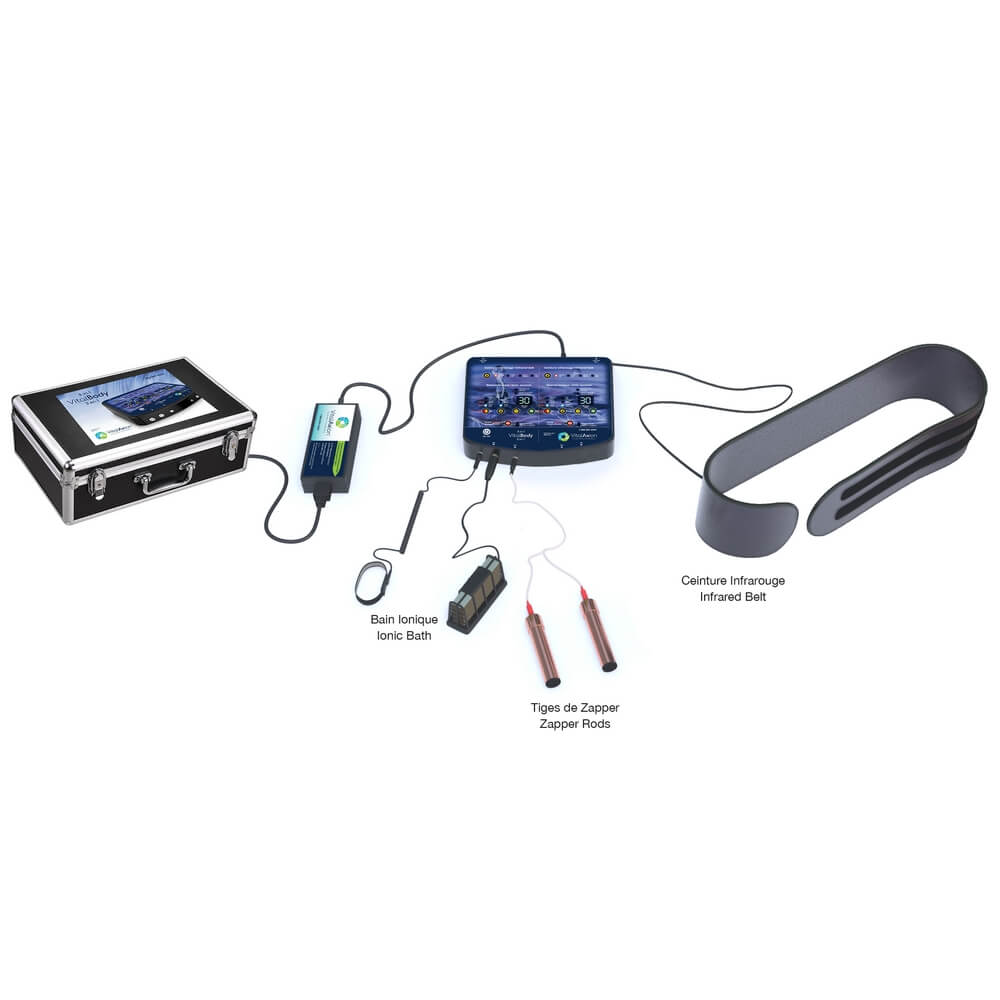
| Part | What it does | What to look for |
|---|---|---|
| Power supply | Converts household AC into low-voltage DC | External and certified, with a recognised mark |
| Main unit | Controls and stabilises the current, times the session | Adjustable levels, alarms, clear controls |
| Array (ionizer) | Carries the current into the water; corrodes over time | Stainless steel, known lifespan, affordable replacement |
| Basin | Holds warm water and salt | Easy to clean; liners available |
| Wristband | Antistatic accessory used with the VitalBody | Detected by the device, with an alarm if not connected |
| Liners | Optional disposable bags for hygiene | Useful for practitioners |
Two kinds of arrays, two kinds of sessions
Arrays differ in shape and in how strongly they act, and they change how an ionic foot bath works for you in practice. On the VitalBody, you can choose:
- a triangular ionizer with four 316 stainless-steel plates, for a stronger session in which some people feel a light tingling (triangular ionizer);
- a cylindrical ionizer with two internal 302 stainless-steel coils, for a gentler session without the tingling, often preferred by beginners, sensitive people and older users (cylindrical ionizer).
Both last roughly 30 to 40 half-hour sessions.
What you feel during a session
Most people feel warm water and nothing else. Some notice:
- a mild tingling, especially with the stronger array or at higher power;
- a sense of relaxation, partly from simply sitting still with warm feet for half an hour;
- a feeling of lightness afterwards.
A strong or unpleasant electrical sensation isn’t normal. Stop the session and check the setup. The device should never deliver a shock, and the feet should never touch the array.
What the science does and doesn’t support
Here’s an honest summary of how an ionic foot bath works according to the evidence.
Well established: electrolysis happens. Gas forms, metal corrodes, the water changes color and hydroxide ions build up at the cathode. This is basic chemistry.
Not established: that an ionic foot bath draws toxins or heavy metals out of the body through the feet. The thick outer layer of skin, the stratum corneum, is a strong barrier, and a 2012 study published in the Journal of Environmental and Public Health found no meaningful release of toxic elements through the feet.
Still debated: the effects of negative ions in general. Most research concerns negative ions in the air, not in water. A 2013 meta-analysis in BMC Psychiatry found that high-density negative air ions were associated with lower depression scores in some studies, with no consistent effect on other measures of mood. Those findings can’t simply be transferred to foot baths.
That’s why we describe the VitalBody as a wellness device for relaxation and personal well-being, not as a medical treatment. See our users notice for the full statement.
How the VitalBody puts this into practice
Our 3-in-1 VitalBody applies these principles with a few engineering choices:
- an external 24 V certified power supply, so no mains conversion happens next to the water;
- a processor that stabilises current between 1 and 3 amps and alternates polarity;
- alarms for salt level and wristband connection;
- two array types for stronger or gentler sessions;
- a polycarbonate shell and bilingual soft-touch controls, assembled and repaired in Sherbrooke.
You can see the complete device on the 3-in-1 VitalBody page, or compare options with our guide to the best ionic foot bath.
Safety features: how an ionic foot bath works safely
Knowing how an ionic foot bath works also tells you which safety features matter. Because the device runs current through water close to your skin, look for:
- an external, certified power supply, so mains voltage never enters the unit next to the basin;
- current limiting, so the current can’t climb if the water becomes too salty;
- alarms or automatic shut-off when something isn’t right;
- no exposed electrodes: the array sits in a housing, and your feet shouldn’t touch it;
- clear contraindications in the manual.
Our contraindications page lists who should not use the VitalBody, including people with a pacemaker or other implanted electronic device, pregnant women and young children.
Common setup mistakes
Most problems we hear about come from a few simple mistakes:
- Too much salt at the start. Add salt gradually. Too much salt pushes the current up and darkens the water quickly.
- Water that’s too hot. Warm and comfortable is enough; very hot water is unpleasant and speeds up corrosion.
- A dirty or worn array. Scale and rust reduce performance and produce more flakes. Clean it regularly and replace it when it’s worn out.
- Feet touching the array. Keep the array to one side of the basin, with your feet clear of it.
- Skipping the manual. Each device has its own settings and alarms. Read the instructions once before your first session.
Troubleshooting: what the device is telling you
Once you know how an ionic foot bath works, its warnings make sense. Here’s a guide based on the VitalBody, though most devices behave similarly.
| What happens | Likely cause | What to do |
|---|---|---|
| Low-conductivity alarm, or very little current | Not enough salt in the water | Add a small pinch of salt and wait a moment |
| Device reduces power or stops | Water too conductive (too much salt) | Add plain warm water, or start again with less salt |
| Wristband alarm | Wristband not connected or not in contact with the skin | Check the connector and the strap |
| Strong tingling | High power or the stronger array | Lower the power or switch to the gentler array |
| Water darkens within minutes | Lots of salt, hard water or a worn array | Use less salt; clean or replace the array |
| Lots of flakes | Scale or an array near the end of its life | Clean with citric acid; check its age |
Ionic foot bath vs. a plain warm foot soak
People often ask what an ionic foot bath adds compared with simply soaking their feet in warm water. The honest answer: the warm water, the rest and the ritual are shared by both, and they explain much of the relaxation people describe.
The ionic foot bath adds electrolysis, with its bubbles, gentle tingling for some users, and the color change. Some people enjoy that experience and the structure of a timed session. Others are happy with a plain foot soak. Knowing how an ionic foot bath works lets you decide what you’re paying for.
The electrochemistry, for the curious
If you’d like to see how an ionic foot bath works at the level of molecules, here are the main reactions in simplified form.
At the negative electrode (cathode), water gains electrons and splits:
2 H₂O + 2 e⁻ → H₂ (gas) + 2 OH⁻.
That’s where the hydrogen bubbles and the hydroxide ions come from. The water right next to this electrode becomes slightly alkaline.
At the positive electrode (anode), several reactions compete:
2 H₂O → O₂ (gas) + 4 H⁺ + 4 e⁻, which releases oxygen and makes the nearby water slightly acidic;
Fe → Fe²⁺ + 2 e⁻, which is the metal of the array dissolving;
and, with salt present, 2 Cl⁻ → Cl₂ + 2 e⁻, a small amount of chlorine that quickly reacts in the water.
In the rest of the basin, the dissolved iron meets hydroxide ions and oxygen and forms iron hydroxides and oxides, the rust-colored particles that change the water’s appearance.
Overall, the basin stays close to neutral, because the acidic and alkaline zones mix. What you see is the product of these electrode reactions, which is the clearest way to understand how an ionic foot bath works and why the array is a consumable part.
What an ionic foot bath can’t do
Understanding how an ionic foot bath works also means being clear about its limits. Based on the chemistry and the available evidence, an ionic foot bath:
- can’t diagnose anything. The color of the water isn’t a measurement of your health.
- can’t be shown to pull toxins or heavy metals through the skin. The skin is an effective barrier, and the research to date hasn’t found that effect.
- can’t replace medical treatment. If you have a health condition, follow your health professional’s advice and ask them before adding any wellness device to your routine.
- can’t do more with more power. Higher current mainly means faster corrosion of the array and darker water.
What it can offer is a structured, relaxing half hour with your feet in warm water, which many people simply enjoy.
If you are considering a device, the most useful question isn't whether it detoxifies, but whether you will enjoy the routine and whether the device is safe and well supported. You can answer those questions before you buy, by reading the manual, checking the contraindications and talking to the manufacturer.
Seeing how an ionic foot bath works in person, at a practitioner's, usually answers more questions than any article. Our session locator lists practitioners who can show you a session from start to finish.
Frequently asked questions
How does an ionic foot bath work?
A device runs a low-voltage direct current through warm, slightly salted water using a metal array. The current causes electrolysis: water splits into gas and ions, and the metal plates slowly corrode, which changes the water’s color. You keep your feet in the water for about 30 minutes.
Why do you add salt to an ionic foot bath?
Salt makes the water conductive so the current can flow and electrolysis can happen. Without salt, very little current passes through ordinary tap water.
Can an ionic foot bath give you an electric shock?
A properly designed and certified device runs on low-voltage current and has safety limits. Some people feel a mild tingling, but a strong or painful sensation isn’t normal, so stop the session and check the setup.
Does an ionic foot bath remove toxins?
There’s no reliable evidence that it does. A 2012 study found no meaningful release of toxic elements through the feet. The device produces a relaxing ritual, and it isn’t intended to diagnose or treat any condition.
How long does an ionic foot bath session last?
Usually about 30 minutes. Our article on ionic foot bath frequency explains how often to use one and how much rest to leave between sessions.
The bottom line
Now you know how an ionic foot bath works: low-voltage current, warm salted water, a corroding metal array and about half an hour of rest. The chemistry is simple and real. The health claims you’ll see online often go far beyond it. Choose a well-engineered device, use it as recommended, and enjoy it for what it is.
Want to know how often to use one? Read our guide on ionic foot bath frequency, and see how the VitalBody is built as an ionic foot bath made in Canada.
This article is for general information only and is not medical advice. Ionic foot baths are wellness devices and are not intended to diagnose, treat or cure any disease. If you have a health condition, are pregnant, or use an implanted electronic device, talk to a health professional before using one.

